
|
SEND AND INCLUSION AT FAIRLIGHT |
||
|
Fairlight Primary School is an inclusive school where we ensure all children work towards our vision that ‘Every individual child achieves’. It aims to be a learning community for all, fostering positive partnerships with parents and carers. It is a diverse and caring school where children are happy, where difference is celebrated and all successes are applauded. All children matter and should be enabled to achieve through dynamic leadership, quality first teaching, excellent resources and support for their individual needs. We aim to ensure that our school is a calm, safe, stimulating, vibrant, purposeful, welcoming, fun, accessible and positive learning environment. We believe that all children have a right to an education that meets their needs. We are committed to reducing the barriers to learning for all pupils, not only those defined as having Special Educational Needs (SEN). We recognise that creating an inclusive school requires time, commitment, support and reflective practice. We also recognise that many children will have additional needs at some point in their childhood. You can find our SEN policy information report here. The Brighton and Hove Local Offer website can be found here Special educational needs and disabilities |
||
 |
 |
 |
|
|
|
Jason Hammond Inclusion Lead Speech and Language Teacher |
 |
 |
 |
|
|
Juliana Ashworth Attendance Officer |
Susie Grey Play Therapist |
|
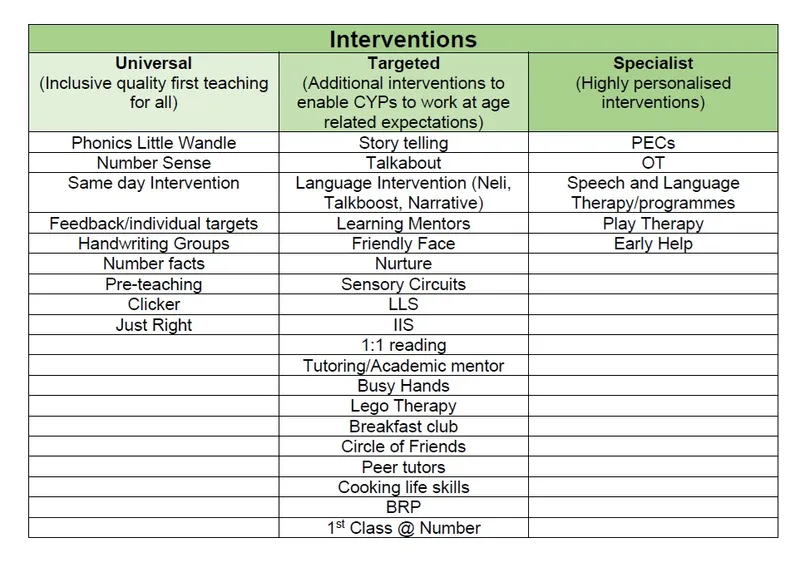
Our approach to teaching pupils with SEN Teachers are responsible and accountable for the progress and development of all the pupils in their class. High-quality teaching is our first step in responding to pupils who have SEN. This is adapted for individual pupils. We will also provide different interventions, as shown below.
|
||
|
|
||
| Speech and Language | Mental health | Support for Parents |
PHYSICAL CONTACT STATEMENT
At Fairlight Primary & Nursery School, we know that positive, caring relationships are at the heart of helping children feel safe, secure and ready to learn. Appropriate physical contact can play an important part in this—whether that’s offering reassurance when a child is upset, guiding them safely, or supporting them during learning activities.
Our updated Physical Contact Statement sets out clearly how and when staff may use touch in school. The purpose is not to reduce warm, supportive interactions, but to make sure that any physical contact is kind, safe, and in the best interests of every child. We want all children to feel comfortable, respected and confident about their personal boundaries.
Key points include:
- Touch is always intentional, gentle and appropriate for the child’s age and needs.
- Staff use approaches such as a “school hug” (a brief, side‑on hug) to reassure children while keeping professional boundaries clear.
- Physical contact is never used casually, and staff always consider a child’s preferences, comfort and individual needs.
- Practices such as lap‑sitting and tickling are discouraged, while some developmental exceptions exist for our youngest children.
- Safety, safeguarding and children’s rights remain central to every decision.
We hope this statement reassures you that we value positive relationships and understand the importance of touch in children’s emotional wellbeing—while being absolutely clear about how we use it responsibly and professionally.
If you have any questions, please feel free to get in touch.
Use of Physical Contact Statement can be found here.
-
Speak to your GP – Tell your GP that you would like to use your Right to Choose for an autism or ADHD assessment. Your GP will need to make the referral, so it’s helpful to say which provider you’d like to use.
-
Choose a provider – You can search online for NHS-approved Right to Choose providers for autism and ADHD assessments (for example, Clinical Partners or Psychiatry UK). Check that they offer services for children and that they hold an NHS contract.
-
Provide information – Your GP may ask for background details such as school reports or observations. This helps the provider understand your child’s needs.
-
Referral and waiting time – Once the referral is sent, the provider will contact you directly to confirm receipt and give you an estimated waiting time.
-
Assessment and follow-up – After the assessment, the provider will share a report with you, your GP and sometimes your child’s school, to support next steps.
Policy on Private Therapists/Practitioners
Our Policy on Private Therapists/ Practitioners can be found here.